

A Brief February
My reading metamorphosis, reviews of everything I read in February & the politics of categorising translated books.

Victim by Andrew Boryga is the next book we are reading for Martha’s bi-Monthly Book Club. Our next meetings are 15th & 19th of April. Details can be found here.
In January I announced I was in a slump, and in February it only continued, although there were some key differences. Namely, I am not calling it a slump anymore, and thinking of it more as a metamorphosis. In January I was fighting the change, which resulted in a lot of reading apathy, but in February, I just gave up. I gave up on the expectations I have on my reading life - rather than the act of reading itself. Reading is such a core tenant of my identity, it is not something I can just abandon.
I spent the month reflecting on how I used my reading life to generate purpose and structure while unwell. I turned to reading for everything; intellectual stimulation, socialising, escapism - but also to find a sense of achievement, order and progress. As I continue to ‘get better’, I don’t need to turn to my reading as much for these emotions, I can find them elsewhere. Thus, I think this is where the ‘slump’ is coming from, and realising that my relationship to what I need, and want, from my reading has changed. I still want all of these things, but in a less intense way.
I decided to expect nothing from my reading in February. Yet, I defied my expectation by reading four books! At the end of the month we went on holiday, and this change of scenery really helped. When you’re away from home, you’re almost forced to think about what makes you ‘you’. Being separated from your routine, and belongings, gives you distance and makes you think differently. Most crucially, if you’re a physical book reader, being away means you can only read the books you brought with you. This was helpful and removed the limitless possibility of all the unread books I have at home.
The effectiveness of this, and reading Sara Hildreth’s recent advice about how she approaches feeling out of rhythm with her reading life, means I am going into next month with a new approach. Sara mentions a technique of ‘the next five’, and it is as self explanatory as it sounds. I have historically not been someone who likes to follow a list with my reading, but the lack of choice while I was away was great. I suspect the fifty (plus) unread books I have around me at home are giving me an element of decision fatigue.1
February Reads
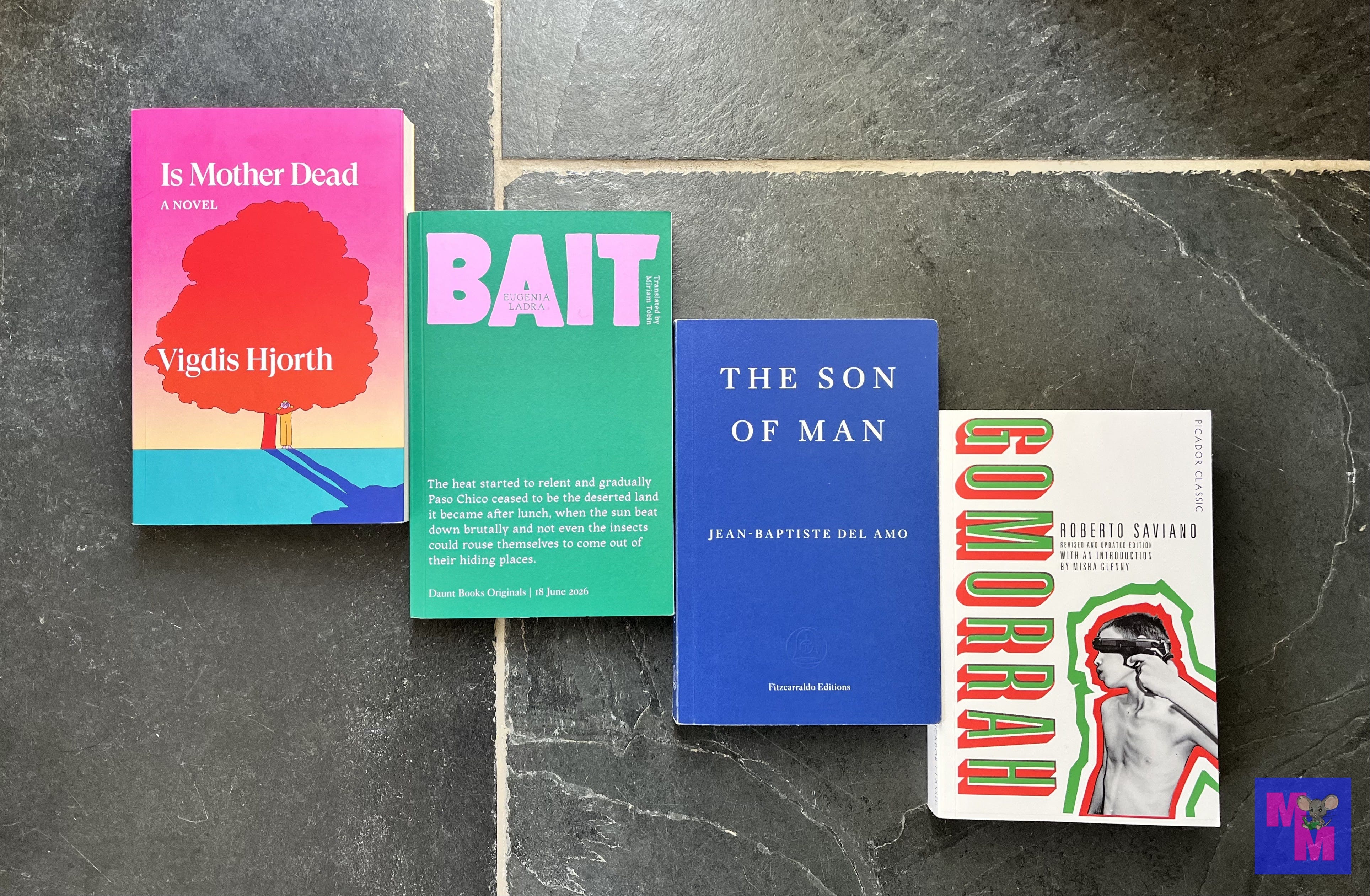
All of these books included fascinating portraits of exclusion and violence in very different, but equally poignant ways!
To see the translated reads from February on Martha’s Map, including authors from Norway, Italy, France and Uruguay, click here.
For those who are new, buy, borrow, bust is my recommendation key: Buy = I loved this book and highly recommend it. Borrow = I liked this book and think it is worth a read. Bust = I wouldn’t recommend this book from my reading experience.
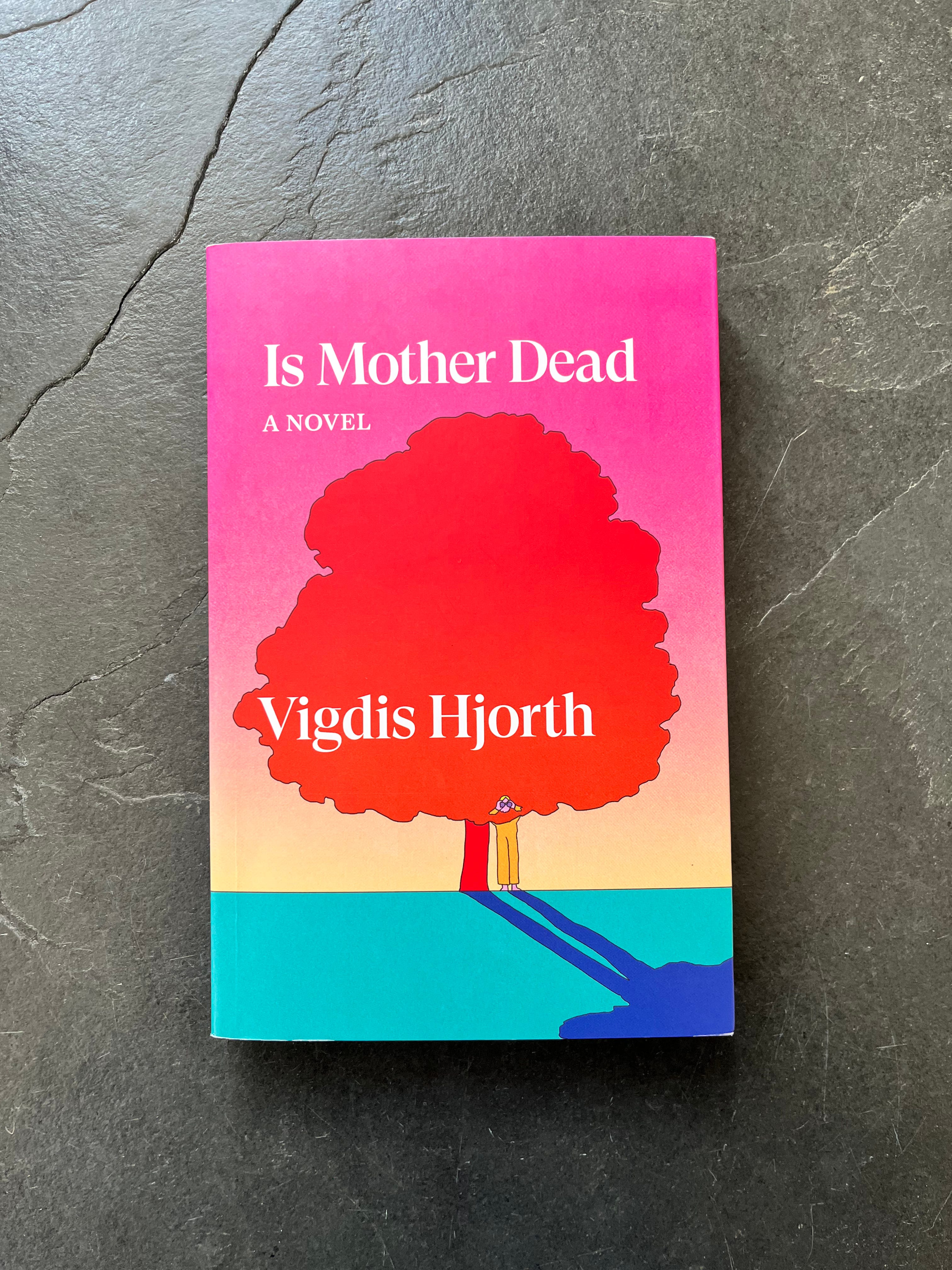
‘Is Mother Dead’ by Vigdis Hjorth (translated by Charlotte Barslund)
Johanna is a recently widowed artist in her sixties, who has returned to her home country of Norway after a long absence, because her work is going on display. The subject of her work is motherhood, and her controversial paintings have opened a rift between Johanna and her mother. But this rift started decades earlier, when Johanna abandoned her law career and husband for a new life, and man, in America - and her mother stopped talking to her. Johanna’s new exhibition re-highlights the prickly relationship with her mother, because now they live just around the corner from each other.
Hjorth has this remarkably perceptive ability to craft incredibly rich inner worlds with her protagonists. Is Mother Dead is entirely narrated through Johanna’s interior monologue, one which circles the same moments from her childhood, her family dynamic and the wounds they have given her. Johanna obsessively thinks about her relationship with them, yearning for contact, while simultaneously feeling relieved she no longer knows them. It is claustrophobic to witness Johanna insistently revisit the same scenarios to look for something new, while nothing is ever being confronted or resolved. In watching Johanna obsess about being right, we begin to understand some of her flaws.
Johanna has been entirely isolated by her family for going against ‘their mythology’ - what they believe is the important, and correct, way to lead a life. But we uniquely only receive Johanna’s perspective, almost mythologising her mother. In trying to come to terms with their estranged relationship, Johanna goes through emotions of paranoia and almost mania, trying to justify and understand it. Johanna is not presented to us as a victim, but rather someone who sought individuality and difference, which could only be achieved if she broke away.
‘Every mother in every childhood represents madness. That your mother is and always will be the strangest person you will ever meet’ 2
There is a feverish toxicity between their relationship, and neither of them are able to concede. While initially we perhaps feel sorry for Johanna’s extradition from the family, as the novel progresses, her actions escalate and she manages to lose control of the very narrative she is trying to tell, revealing an obsessive, slightly unforgiving nature. Johanna is a mother herself, and in trying to understand her own mothers blindspots, she reveals to us some of hers.
Most compellingly this novel interrogates gendered dynamics of the roles that women are expected to fill. Hjorth ruminates on female roles; the devoted daughter, the subjugation of being a housewife, the rejection of ‘motherhood’ tropes in order to gain independence - they all ponder on the images women are expected to maintain, and the horror if they reject them. Is Mother Dead is as much about mother daughter estrangement as it is about the roles women are expected to perform when it comes to maintaining relationships.
I enjoyed this and would call it a buy! I loved how it is told in varying length vignettes - for someone who is struggling to read a bit, the brevity of how Hjorth tells this story is incredibly accessible. I did not love it as much as Will and Testament, but it is as equally profound. I think I’ll read Long Live the Post Horn from her next.
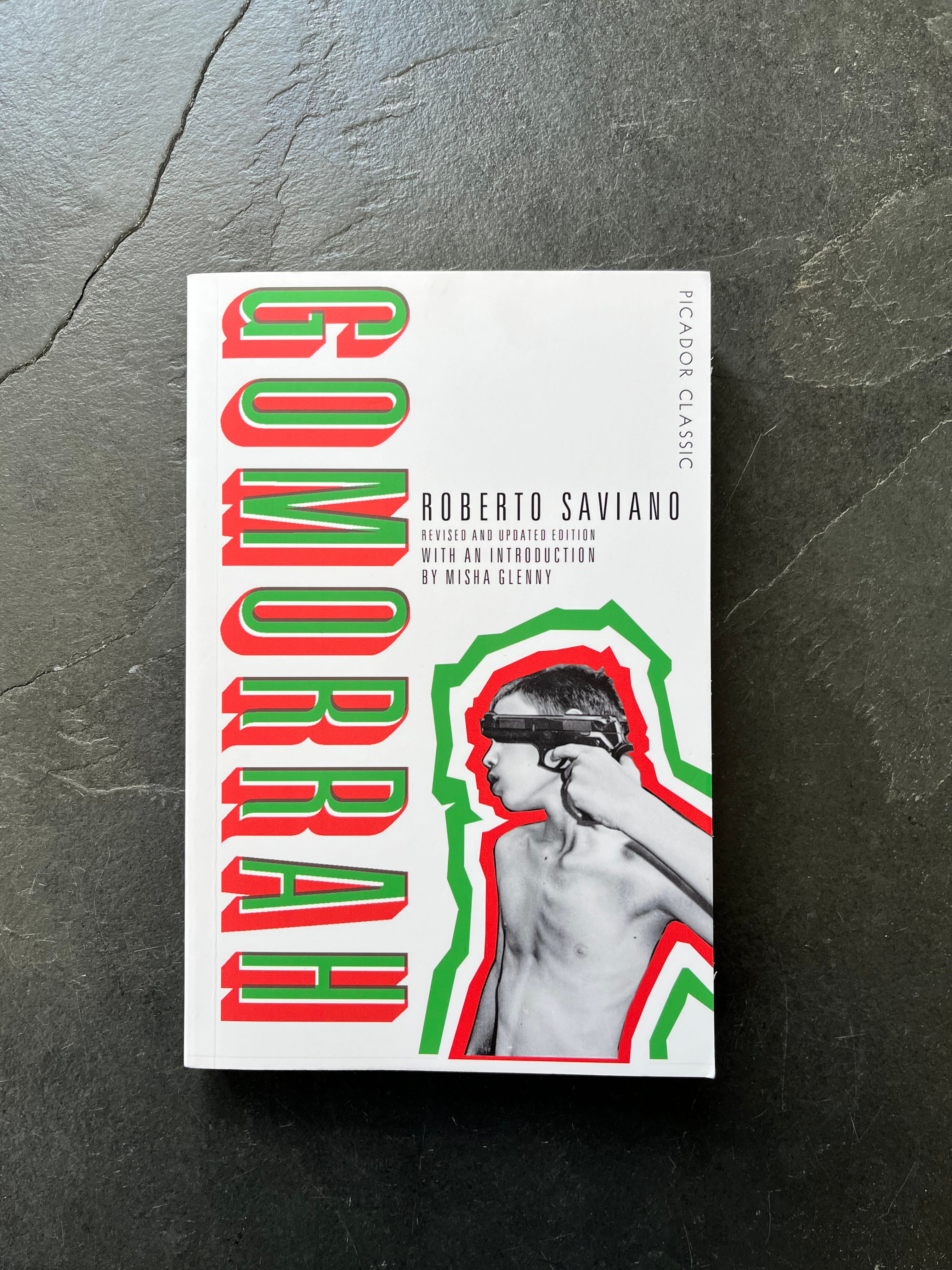
‘Gomorrah’ by Roberto Saviano (translated by Virginia Jewiss)
Gomorrah has a sensational opening; a crane moves a shipping container at a port and the hatches on it break, spilling out dozens of frozen, dead bodies which smash over the ground. These corpses of Chinese workers are being returned to their homeland for burial so their paper identities can be acquired by new immigrants. This opening feels inline with the sensationalist image of the Mafia we have been fed in the media by films like The Godfather. An image that suggests the Mafia are as glamorous as they are dangerous, as suave as they are violent. It is a very specific image that can be romanticised in its mystery.
But Gomorrah swiftly crushes any sensationalism of the Mafia through investigative journalism that is rooted in dissecting as many aspects of the machine as possible, from someone who has lived among it. Saviano reminds us at every moment that this, the Camorra, is a business. It is a business that controls more aspects of the economy than one could conceive. They monopolise industries, but not just ‘criminal’ ones like prostitution or drugs. They also monopolise waste disposal, cement and garment production - much less glamorous than you might have thought.
Saviano was born in Naples and grew up in Campania, an area controlled by the Camorra, one of the oldest and largest criminal organisations in Italy, that has one of the highest murder rates in the world.3 He immediately establishes that being involved is not a choice when you are born in an area like this, it is a crippling nightmare thrust upon you. He said he ‘wanted with my very being to change the reality around me, a reality that disgusted me.’ While he now lives under police protection, and has done for seventeen years, the success of his work lies within the fact that his written word is considered a such a threat. He refused the suggestions that he should publish his work under a pseudonym, wanting his name to represent a defiance, which he is still dealing with today.
Despite everything that is sizzling about this book, Gomorrah is sometimes weighted by its detail. Detail is not something that is not bypassed here - with every high profiled Mafia figure named, repeatedly, when relevant. Occasionally this became tiresome, but whenever it did, I remembered who this book was published for; Italians who were sick to death of successive governments who allowed organised crime to play such a suffocating role in their lives. Saviano wrote this book for them, to expose and explain the system as best he can. Though many come to read Gomorrah for enjoyment and out of interest, it became a cipher for millions of Italians to help them understand the systems that influenced their lives. They could finally put a name, or several names, to something which has been shrouded in secrecy for over a century.
Gomorrah’s most complex, and compelling, portraits are those of the communities that are involved, but not by choice. Saviano describes a scene where law enforcement suddenly appear in Secondigliano, and in response, hundreds of women pour onto the streets, ‘setting trash bins on fire and throwing things at police cars’. Saviano explains; they are protecting their sons, nephews and neighbours being arrested - who are also their employers. It is not solidarity but rather ‘a rage that is both a defence of their territory and an accusation against those who have always considered it a [...] place to forget’.4
Most profoundly, Gomorrah emphasises the social mobility the Camorra gives to residents, and how furious it makes them that they can only access such mobility through them. Saviano’s analysis on how it is an environment that leaves young girls aspiring to marry a Camorrista for security, and young boys becoming pushers because it is the only employment available, is incredibly nuanced.
What prevents Gomorrah from being entirely dense reportage is Saviano’s own perspective throughout the story. His emotion and anger is palpable throughout, his sensibility anchoring the narrative in all its chaos. I’d recommend this book and call it a borrow! I learnt an extensive amount while reading it and felt incredibly touched by Saviano’s bravery throughout his attempt to demystify the Camorra for his community.
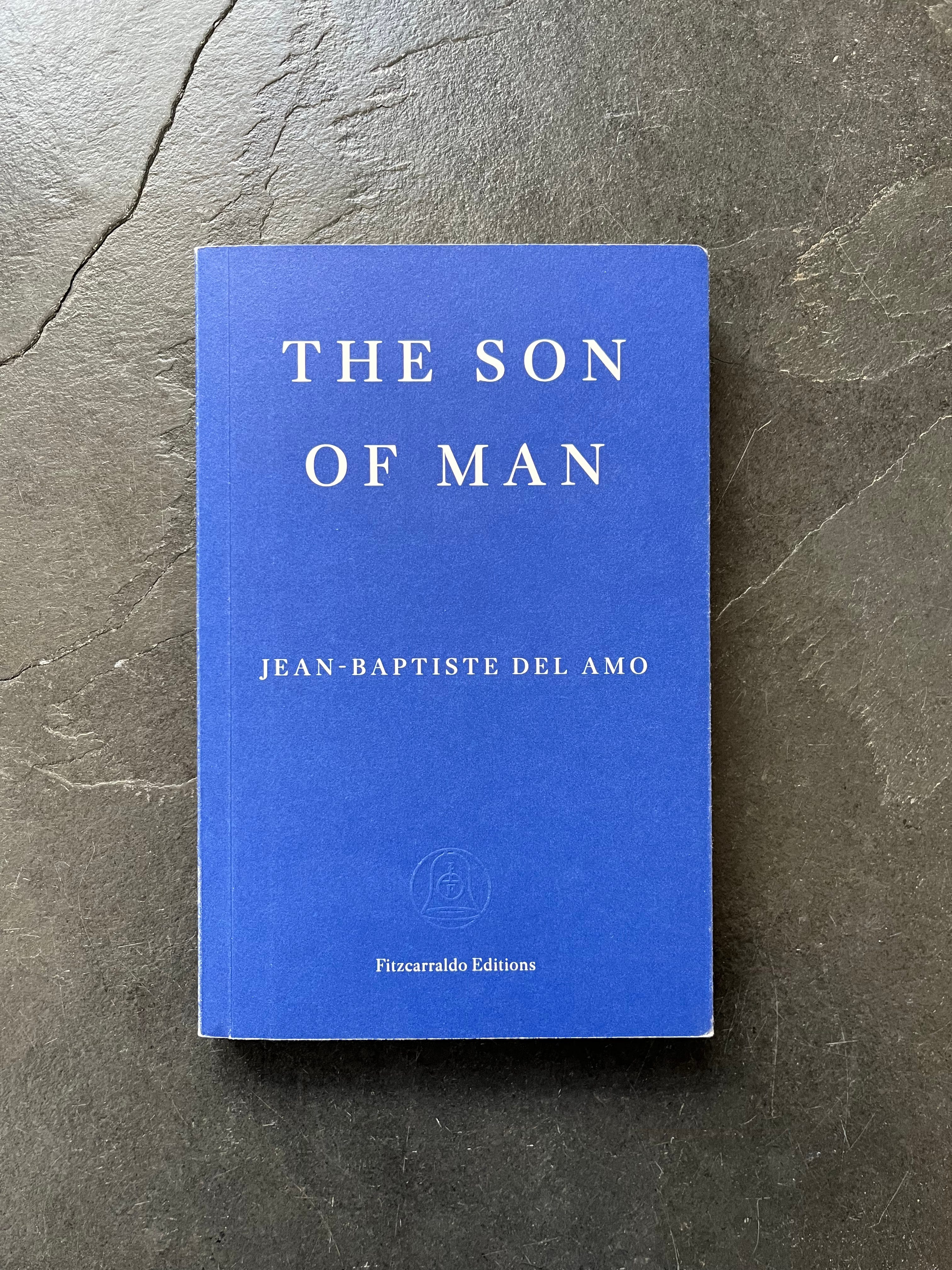
‘The Son Of Man’ by Jean-Baptiste Del Amo (translated by Frank Wynne)
After several years of unexplained absence, a father reappears unannounced in the life of a woman and their young son. Intent on being a family again, the father takes them away from their home and drives them to Les Roches, a dilapidated house in the middle of the mountains, where he grew up with his own ruthlessly unforgiving father. The longer they are there, the father’s hold on them intensifies, and the possibility of returning to their previous life seems increasingly out of reach. Haunted by his past and consumed with jealousy, the father slowly sinks into madness and threatens to pull them down with him.
The Son Of Man is a tale about the legacy of violence, and whether we are destined to repeat it. It is about the son of one particular man, and the sons of all men. It explores how violence can be generational; something that men are born with that they have an uncontrollable destiny to repeat. The son in the novel is nine, impressionable, sweet natured and incredibly young. Unbeknownst to the son, without his father around, he has escaped this lineage violence. But the father is resolute in trying to mould the son into someone different with his presence, unknowingly bringing him back under the thumb of his ancestry.
The unease of the mother anytime the father is alone with his son, and his unexplained absence, suggests a violent past that she has been at the hands of. While she seemingly does not forgive him, but believes in his capacity to change, it is suggested that she has forgotten the ingrained nature of violence in humanity, and how culturally prolific it is. Though The Son Of Man is a tale about an immediate family, it is evident Del Amo also intends to comment on something bigger about our society.
It is hauntingly tense to read an emergingly unstable man take a woman and a boy he barely knows to live in total isolation in a derelict building. Cut off from the world, the father believes he is going to be able to shape the family unit into something he wants. But in going back to Les Roches he will be overwhelmed by the memories of his own childhood. The sense of place from Les Roches is suffocating, creating a encroaching threat that swallows them up. It seems it is the fathers density to be consumed by whatever consumed his father. Thus, the anxiety of the novel is whether this emotionally perceptive, sweet child will be consumed by this generational horror too.
Del Amo’s prose is unsettlingly haunting as the novel darts between past and present, narrating the story from the perspective of the son who is trying understand his father, whose menace grows with every page. Del Amo writes profound stories that are simultaneously firmly situated on the page, but grapple with the enormous concepts of our society and how we live. The nameless family in The Son of Man ensures this tale is positioned on a broader, almost biblical scale. It reiterates how while writing incredible fictional portraits, Del Amo writes excavations about our humanity - it is exquisite.
I loved this book, would recommend it wholeheartedly and call it a buy! I fell in love with Del Amo’s writing with Animalia. But while Animalia and The Son Of Man are incredibly different, they are both characterised by flawlessly mesmerising prose which interrogate the lineage of violence. This is significantly less gruesome, and much more palatable, than Animalia. I recommend to those who enjoy books that are more philosophical and perceptive about the more primal nature of humanity.
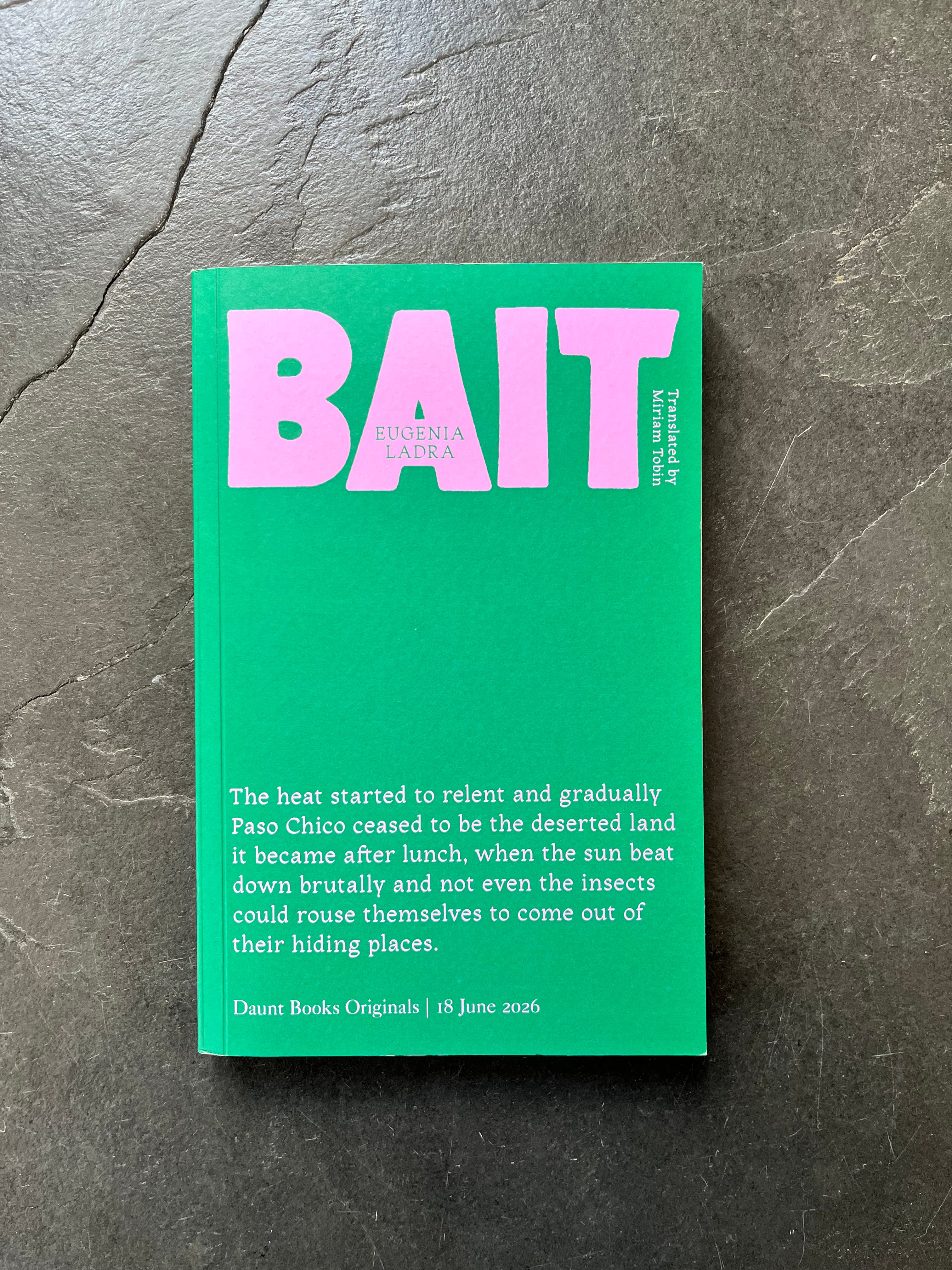
‘Bait’ by Eugenia Ladra (translated by Miriam Tobin)
Marga lives in the insular, static village of Paso Chico, where every Friday a statue of the Holy Mother is moved between houses to spend seven days to oversee prayers. La Paraiso is the only bar in the village, that exclusively the men go into. After spending all night there, they spill out of the bar on muggy afternoons in the blazing sun - every day is the same. Except the day when Marga was born. Marga’s mother died during childbirth, and after a year of drought, Marga’s birthday brought a biblical flood that destroyed half the village, killing chickens, dogs and people. Since, Marga’s name has been synonymous with bad luck.
For her entire life, Marga has been an outsider. But this all changes when Recio appears, found lying beneath a tree. Bait is a provocative and unsettling exploration of morality and societal dynamics. Paso Chico is dripping in atmosphere, charged by gender, religious piety and violence. Marga, a child, carries this burden of misfortune imprinted on her by the village, and is heavily ostracised as a result. But while they treat her as cursed, everyone else appears to embody a moral inertia towards everything else. Marga’s existence is demonised to fit a narrative for Paso Chico’s stagnancy, while the habitual behaviour of men is just accepted as part of the social fabric. There is an unsettling, erotic atmosphere to Bait which positions the reader as a witness to amounting fractures which are inevitably going to end in disaster.
A sense of foreboding drives Bait, creating a suffocating narrative that explores how misogyny shapes, and sustains, particular behaviours in communities. Paso Chico is a community that has created an impenetrable narrative that relies on superstition, one that has allowed everything bad that has happened to be blamed on a little girl. It is a claustrophobic community, steeped in poverty, alcoholism and stray dogs. The stray dogs are, perhaps unsurprisingly, metaphors for some of the men in the story - both are treated with caution and fear.
Bait reminded me of The Winterlings by Cristina Sánchez-Andrade which also explores an insular community that is maintained by secrets and lies. Both novels explore a simmering uncertainty that imbues under the mundane everyday. I thoroughly enjoyed Bait, it felt fresh and engrossingly atmospheric. It is a stimulating contemplation on the mythologies that are created, and sustained by communities, and how it can cause harm.
Myths and the patriarchy come together in Bait to create a suffocating landscape in Paso Chico. I would recommend this and call it a buy! Bait is for those who enjoy provokingly strange narratives that interrogate the mythologies that communities are built upon. It is an absorbing, uneasy tale, that despite some heavier moments, was immensely entertaining to read.
And that concludes my February Reads! I loved all the books I read this month for different reasons, but my favourite would be ‘The Son Of Man’.
My first read of March is ‘Ghostroots’ by ‘Pemi Aguda which is a short story collection. I’m not a huge short story reader, but I am trying to try new things in the wake of my reading life feeling tumultuous.
The Politics of Categorisation
In February, Pandora Sykes asked me to write a piece about translated books for beginners. I tried to write it with those in mind who might assume translated books are intimidating (and assure them they are not). The comments on this post have started an interesting discussion, with several people shocked at the categorisation of ‘translated’ - saying it was reductive, and not a ‘real’ categorisation.
We can only speak from our own experiences, and as a monolingual British woman, I can only comment on the industry as I see it in this country - which is that translated literature is currently popular and being signalled more. I know ‘translated literature’ is something which is very normal to those whose native language is not English, who have grown up constantly reading books in translation.
But the anglophone dominance of culture in this country is extraordinary, and in my opinion, is a contributing factor as to why some people might presume translated literature is inaccessible. While it is a privilege to be born in a country where the native language is one of the most widespread in the world, it can also be a limitation. It can limit your exposure to other cultures and understanding that there are other ways of being. There can be an arrogance in the West that we are the centre of the world - that our ‘life’ is the most worthy. Translated literature challenges this, and in its rising popularity here, everyone is a better reader for it.
Perhaps in a utopia, translated literature would not be signalled out. But from my understanding, only good can come from reminding people it exists. In raising its profile, and subsequently the profiles of the authors, translators and publishers, people are reminded, and encouraged, to read outside of their culture.
This newsletter is read by readers in over 120 countries, so I am curious to know what you think. While this is all the politics of book categorisation, something which we know can be often inaccurate, there seems to be a more impassioned reaction to this than say the categorisation of ‘romance literature’. I wonder if this is an ignorant view because I am English, or whether the publishing industry’s categorisation of translated books is something that is inherently contentious?
What do you think about the ‘trend’ of translated literature in UK/US publishing markets?
Do you think it’s fair to call it a genre? If not - why? What’s the alternative?
Have you ever thought that any media (my newsletter included) specifically naming books as ‘translated’ was reductive?
If someone asked you where to start in reading translated books, what would you recommend?

Speaking of categorising translated books, the International Booker Prize longlist was announced this week!
The longlist is always my ‘favourite’ part of this prize - historically I am not a fan of the short list or the winner. Truthfully, what excites me the most about this list is seeing my favourite four publishing houses (Charco Press, Fitzcarraldo Editions, Perirene Press and Foundry Editions) on there. I read their catalogues religiously and it is a thrill to see them celebrated.
I did not stop talking last year about how brilliant On Earth As It Is Beneath and She Who Remains were- so I love that they are listed. I have copies of The Deserter and The Duke so it is likely I will read them!
For those who want to know what else I am ‘most interested’ in reading;
Women Without Men by Shahrnush Parsipur (translated from Persian by Faridoun Farrokh)
It was originally written in 1989 and you know how ‘into’ reading older books in translation I am! It is also from a part of the world I haven’t read much translated literature from (apart from ‘Disoriental’ by Négar Djavadi which is fab)
The Witch by Marie NDiaye (translated from French by Jordan Stump)
Again because it was published in 1996! And I’m always into witches.
The Wax Child by Olga Ravn (translated from Dutch by Martin Aitken)
More witches! I have been wanting to read this since it came out, but I am waiting on the paperback.
I also love Aitken as a translator, he has translated a lot of Karl Ove Knausgaard who I am an emerging fan of!
Taiwan Travelouge by Yáng Shauāng-zǐ (translated from Mandarin Chinese by Lin King)
I have heard great things, I want to read more Chinese fiction and I love a book that explores colonial history!
The IBP longlist, almost unwaveringly, has a Korean and/or Japanese translation listed so it is interesting to see a deviation from that! This list is very European, and it is a little gutting to only have two Latin American books on it. But, I will say, I think this is the best looking longlist since 2023!
I won’t be reading the longlist because I truthfully can’t be bothered, and do not think that would be a healthy pressure to my struggling reading life right now. But if you do, I’d love to hear what you think!

Let me know your thoughts:
✹ What have you read and enjoyed in January? Do you have any recommendations for me?
☆ Have you read any of these books? Would you like to?
✼ Do you follow the International Booker Prize? What are you pleased to see on it? Or, what do you wish was on it?
✵ Have you ever had a reading metamorphosis, or something similar? If so - tell me about it!
☞ How should we categorise translated books? Should the fact that a book is translated be a USP (unique selling point) or do you think it is wrong to do so?
Thank you, always, for being a reader.
In February we had our first book club meeting and I loved every minute of it - thank you to those who came. I immensely look forward to our next one!
See you soon,
Happy Reading!
Love Martha
If you enjoyed this, or anything else you see on Martha’s Monthly, why share it with a friend so they can enjoy it too!!
Catch up on what you might have missed:


What I was reading in February 2025:

And 2024:

Subscribe if you enjoyed this and want to support the newsletter (and me) <3
The Monthly Reads will always be free, but if you would like to join the book club, consider upgrading your subscription!
Fifty is a complete guess and I am sure it is actually much, much more but I do not want to be confronted with such a horror.
P.306 in Is Mother Dead by Vigdis Hjorth
Stat found p.81 in Gomorrah by Roberto Saviano
Quote from p..93 in Gomorrah by Saviano
I don’t like the term or meaning of a slump, so I love the metamorphosis!
The translation question is such a tricky one! One thing I appreciate about its rise as a 'category' is that it's highlighted the role of translators too. Translation in itself is an artform! I think it's good to have an awareness of how a text might change between languages, and so in that sense, I think the category can be helpful. I can see how it can be reductive to lump them all together, but I also think there’s something lovely about bookshops with ‘translated literature’ tables, not only because it showcases diverse writers, but because different genres get to sit next to each other. I like finding a horror book next to a family drama!